The favourite beach in the summer time.
The Po River Delta, a delicate equilibrium between land and sea created by the river and protected by man, is an area which is still largely unknown, to be travelled through slowly while savouring the softness of the landscape, the emotion of the boat bridges, the open horizons, and the "African" sunsets in summer.
A natural environment and a hospitable one at the same time, offering beaches, tourist ports, and organised itineraries.
Rosolina Mare, my favourite Polesine beach:
The friendly "Bagno Azzurro" at Rosolina Mare:
A stunning sunset at Po River Delta:
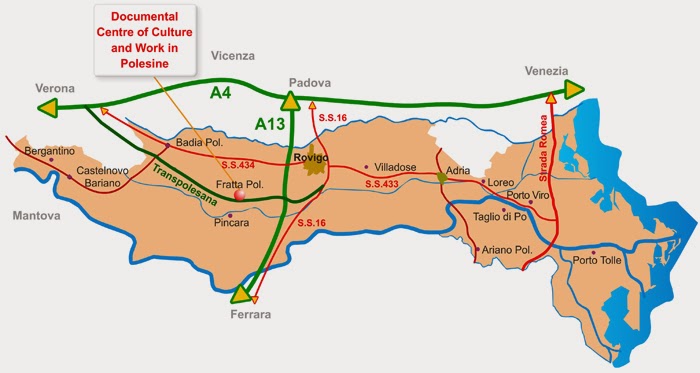
The Polesine map, with area around Rovigo:
Este, a town with very remote origins.
The town became one of the most important italian centres after the year 1000 thanks to the presence of the Estensi family, who erected their castle and fortified the town.
The circle of walls was later enlarged by the Da Carrara family and by the Venetians.
The religious heritage of the town is very rich, too.
The cathedral keeps a beautiful painting by Giambattista Tiepolo (1759) and the tomb of Blessed Beatrice d'Este, who died in 1226 when she was only 26 years old. Her beauty and virtue had enchanted many poets, who dedicated their lyrics to her.
The charme of this town attracted poets and artists even in more recent times, as the great romantic english poets Byron and Shelley.
Este is worldwide famous for the production of artistic ceramics.
Intercession by St. Tecla (by Tiepolo) at cathedral:
The castle with public garden at Este:
Ancient building at Este:
The National Museum of Este is one of the most important archaeological museums of northern Italy, and it's located in the beautiful Mocenigo Palace (entrance must be paid, but at low cost):


Montagnana, a medieval gem of antique splendour.
The fortified city centre remains one of the best preserved and most charming examples of a walled city in Europe
The walls have a circumference of about two km with two gates and 24 towers.
St. Zeno castle, one of the two gates, was erected in 1242 and now hosts the Town Museum. The other gate, Rocca degli Alberi, is a real jewel of military architecture. It was erected in 1360 by the will of Francesco I the Elder of the Da Carrara family.
The narrow porticoed streets of the town lead to the wide Vittorio Emanuele Square, dominated by the Cathedral (works of art by Sansovino and Paolo Veronese inside).
Close to Porta Padova is Villa Pisani a work by Andrea Palladio (1553-1555).
The walls at Montagnana:
St. Zeno castle at Montagnana:
The cathedral at Montagnana:
Set in peacefully surroundings at the foot of the Lozzo hill, Valbona castle is a very well preserved 13th century building and one of the most interesting examples of medieval military fortification.
The castle was restored in the 1980's and hosts now a restaurant and a permanent exhibition about Paduan castles.
The Valbona castle at Lozzo Atestino:
Ospedaletto Euganeo, in the Middle Ages it was a hospice for pilgrims (whence the name).
At Tresto rises a popular Marian sanctuary, built in 1468 in the place where the Virgin appeared to a boatman, that hosts a miraculous painting attributed to Jacopo da Montagnana.
The Virgin painting at Tresto:
The Tresto sanctuary:
Carceri, which developed around St. Mary abbey, founded in the 10th century and entrusted first to the Augustinian and then to the Camaldolite monks.
The original romanesque church, with nave and two aisles was fired in 1643 and replaced with a new baroque one, inaugurated in 1686.
In 1690 Pope Alessandro VIII suppressed the abbey and its lands were sold by auction in order to gain money to give financial support to the Serenissima Republic war against the Turks.
The abbey was bought by the Carminati family who had it transformed into a farm.
In 1951 the Carminati donated the building to the Church of Carceri.
The abbey nowadays hosts a museum displaying traditional country tools (entrance for free).
The abbey at Carceri:
Ponso, a vine and fruit-growing village, remarkable for the little church of S. Maria del Pra', the so-called Ciesazza, built around the year 1000 with salvages from Roman buildings, whose frescoes are unfortunately very deteriorated as well as the whole structure.
The church Ciesazza at Ponso:
A mainly agrarian village that always developed around the Miari de' Cumani villa.
At first a medieval fortress, the building was enlarged and made habitable in the second half of the 17th century, then restructured as a villa in the 18th and 19th century.
The current situation was reached between the second half of the 19th century and 1920, when Jappelli was charged to realize the beautiful romantic park (concluded by Osvaldo Paoletti about 1870) with a lake and a grotto, and Achille Casanova was asked to rearrange the exterior of the palace and of all dependencies, the main front, the central hall and the other internal rooms.
The park and the villa are now open to visits (entrance must be paid).
St. Elena d'Este landscape:
Villa Miari de' Cumani at St. Elena d'Este:
The area was purchased by the Pisani family in 1469 due to the extinction of the previous owners.
The parish church of the Blessed Virgin of the Snow was built by the Pisani in 1536-63 and rebuilt, large and more beautiful, in 1648 after an Adige flood.
During the last war the church was bombed and damages were restored only in 1967.
The church at Boara Pisani:
The Adige river at Boara Pisani:
Stanghella, a marshy spot inhabited since the Neolithic Age.
After 1468 the Pisani family purchased the whole area and settled there the centre of an enormous farm that gave origin to the village.
The parish church of St. Caterina is due to the Pisani family: is was founded in 1593, rebuilt in 1664 and enlarged at the half of the 19th century.
Also worthy is Villa Centanini, degraded but with a precious large park.
The church of St. Caterina at Stanghella:
Villa Centanini at Stanghella:
The library and museum at Stanghella:
A fine villa in the rural landscape.
In Bagnoli di Sopra Villa Widmann was particularly famous in the 18th century when Venetian playwright Carlo Goldoni played in the private theatre of the mansion.
Today the noble dwelling, which is surrounded by wide park with numerous statues, houses a famous wine-cellar (entrance for free).
The church and Villa Widmann at Bagnoli di Sopra:
Villa Widmann at Bagnoli di Sopra:
A little town, but something of interest.
Pernumia is located about 20 km southwest of Padua.
Since the early XV° century Pernumia's history coincided with the Republic of Venice's.
Birthplace of Angelo Beolco, alias the Ruzante, Pernumia was important in the making of his name and the mask that made him famous worldwide.
The pluricentenary history of Pernumia is all contained in its churches and buildings.
Pernumia landscapes:
The Archpriest's church at Pernumia:
Villa Maldura Bonacossi at Pernumia:
A beautiful villa in the Paduan province.
Villa dei Vescovi in Luvigliano di Torreglia is the most important pre-Palladian country house of the Renaissance. Built between 1535 and 1542 on an embankment of the Euganean hills as a holiday home for the bishop of Padua. The villa was designed by the Veronese painter and architect Giovanni Maria Falconetto, under the direction of Alvise Cornaro, an erudite Venetian. The piano nobile is enriched by a cycle of frescos on which the Flemish painter Lambert Sustris started work in 1542, many of which faithfully evoke the sublime surrounding landscape. A place that stimulates contemplation, reflection and meditation (entrance must be paid).
 The friendly "Bagno Azzurro" at Rosolina Mare:
 A stunning sunset at Po River Delta:
 The Polesine map, with area around Rovigo: